
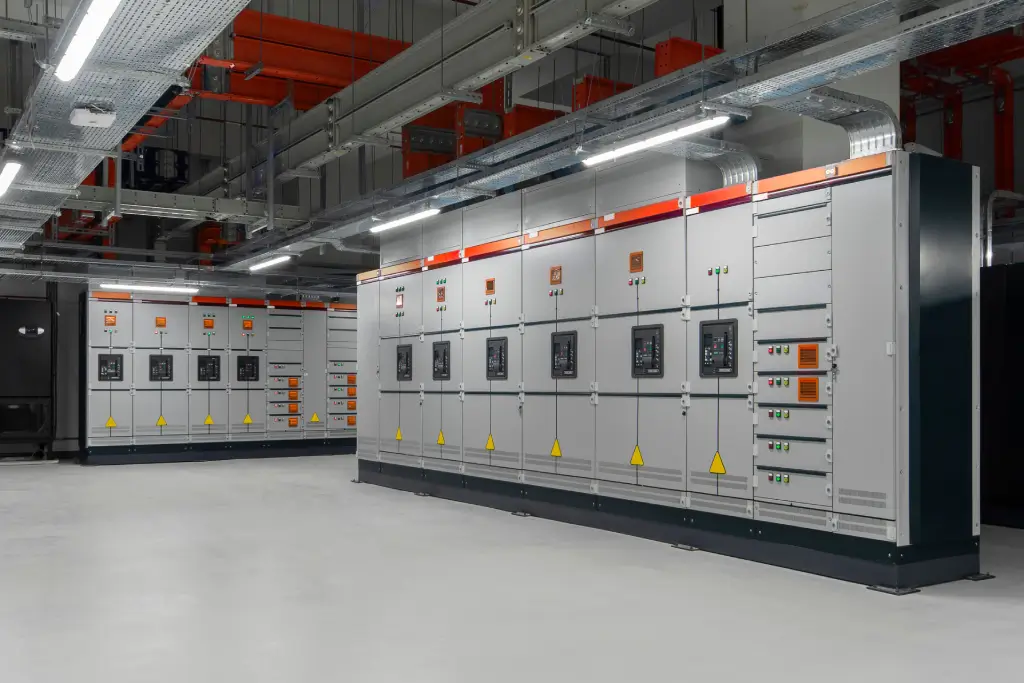
Find the fault before it finds you.
Infrared scanning of your switchboards under live load — catching loose terminations and developing faults while they are still cheap to fix.
Level 2 endorsed report included.
No shutdown required — we scan live, because that’s the only way it works.

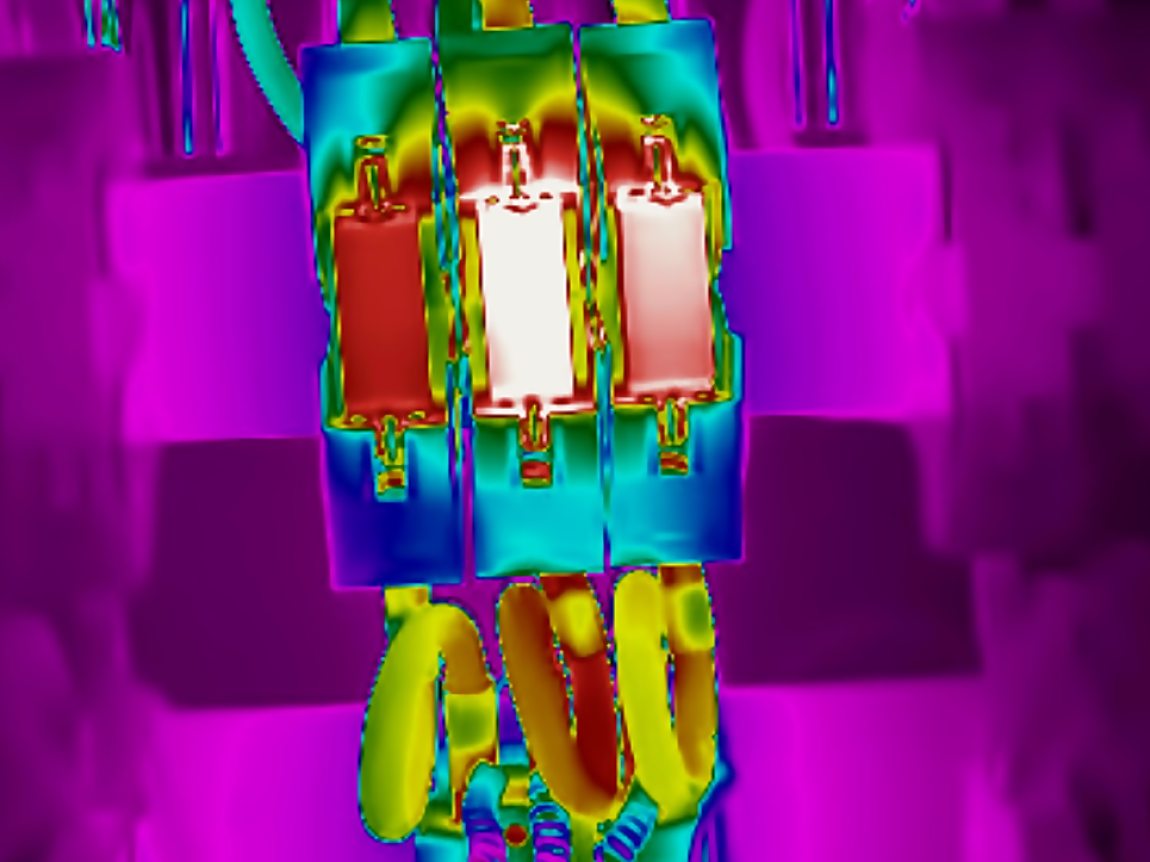
Identical fuse ways, side by side. To the eye there is nothing to choose between them. In the infrared, one is running far hotter than its neighbours. Same board, same second — an actual CSE scan.
A loose termination gives you months of warning. You just can’t see it.
Resistance climbs, the joint runs hot, and it keeps running hot for weeks before it finally lets go. Nothing about that shows on a walk-past inspection. It is unmistakable on a thermal image.
Unplanned downtime
A failed incomer at 3am takes out a floor, a tenant or a production shift. An emergency callout costs far more than a planned scan.
Fire risk
An overheating joint inside a switchboard is a well-known ignition source. Thermography finds it while it is still just warm.
Evidence on file
A dated, Level 2 endorsed report your LEW, your board and your insurer can all use.
What we scan
Anything in the distribution chain that carries current and can develop resistance — scanned live, so your building keeps running.
Main switchboards
Incoming ACBs, busbar joints and chambers, riser tap-offs, cable terminations, CT connections and neutral links.
Sub-boards, DBs & fuse switches
Sub-switchboards, distribution boards, tenant TOU boards, fuse-switch ways, MCCB and MCB terminations and contactors.
Connected plant
Capacitor banks, ATS and changeover panels, motor starters, chiller and pump panels, solar and EV supply boards.
Our rates, in full
Per board, one premises, normal weekday working hours. Count your boards against the tiers and you will know roughly what your site costs.
| Board | Per board |
|---|---|
| Main switchboard (MSB) — by rated capacity | |
| Single board up to 400A | $500 |
| Up to 1,600A | $1,000 |
| Up to 3,200AE.g. 2 × 1,600A incomers = 3,200A | $1,200 |
| Up to 6,400A | $1,500 |
| Additional MSB / sub-board / DB / TOU — by each board’s own rated capacity | |
| Up to 300A | +$100 /board |
| Up to 800A | +$200 /board |
| Up to 1,600A | +$300 /board |
| Up to 6,400A | +$350 /board |
| Once per premises | |
| MobilisationHowever many trips it takes. A second visit to catch a board under load is on us. | +$200 |
Roughly what will it cost?
Indicative onlyNot sure of your board count? Send us your single-line diagram and we will count them.
Volume discount 10% above 6 boards, 15% above 15 boards, per premises on one visit. Re-inspections of faults found on the initial scan cost the $200 mobilisation fee only. MSB means the site’s incoming main switchboard; everything downstream is additional. Boards above the tier maxima and sites needing special access are quoted separately, always upfront. All prices before GST; rates valid 90 days from quotation.
Most thermographers hand you a report. We can also fix what’s in it.
A scan-only vendor finds your hot spot and leaves. We scan, quote the rectification, do the work with our own people, and come back to prove it’s fixed.
| Scan-only vendor | Cheng Seng Electric | |
|---|---|---|
| Level 2 endorsed report | ||
| Opens and reseals the panel | Varies | Our own qualified technicians |
| Can rectify what it finds | Varies | In-house LEW & direct workforce |
| Re-scan after rectification | Varies | $200 mobilisation only |
| Subcontracted labour | Varies | Our own in-house Level 1 & Level 2 thermographers |
| Track and monitor energy consumption | Varies | GEMS — see the trend behind your load |
A scan shows one day’s condition. If you’d also like to see how consumption behaves over months, our GEMS platform tracks it continuously — entirely optional, and it pairs naturally with scanning.Explore GEMS
Established 1940 · 86 years · 50+ staff · 10+ vehicles island-wide · 2 in-house Licensed Electrical Workers.
Scan once, or make it the routine
Most of the value in thermography comes from doing it every year, not once. A single scan tells you the condition of a board today. A second scan a year later tells you which joints are getting worse — and that is the finding that actually prevents a failure.
An annual programme
Your appointed LEW already has to inspect and certify the installation each year. Scanning at the same visit means one set of access arrangements, one coordination effort, and a thermal record that lines up with your compliance file.
We hold the schedule and come to you. You stop having to remember it.
Across a whole portfolio
- Every building scanned to the same scope, reported in the same format
- One point of contact and one consolidated summary for the asset team
- Year-on-year comparison per board, so a slow-degrading joint shows up before it fails
- Portfolio pricing rather than building-by-building quotations
Portfolio programmes are priced on the estate, not per building — tell us how many properties and roughly how many boards, and we will put a figure and a schedule to it. Talk to us about a programme
From enquiry to report
Send your SLD
Your single-line diagram shows every board and its rating — that is all we need. Fixed price back, no site visit needed.
Agree a window
Normal working hours, when your boards are loaded. We check our earliest available window and confirm a date with you.
Scan under live load
We open the panels, scan every accessible joint with calibrated Fluke imagers, record load and ambient, and reseal. No shutdown.
Findings report
Image pairs, temperature rise, severity and a recommended action. Level 2 endorsed. Anything critical is phoned through the same day.
Rectify & re-scan
Repairs quoted separately, so you can use your own contractor. If you use us, the re-scan is $200 with no board rates.
 CSE thermographer
Scanning an opened LV cubicle under normal load. Nothing is switched off to take this reading.
Our own thermographer, at your board
No agency crew and no unfamiliar face in your switch room. The person in this photograph is CSE staff, and it is the same team that comes back next year.
-
Level 1 and Level 2, in house
CSE employs its own certified thermographers. The scan, the interpretation and the report are done by the same people, so nothing is handed to a third party and nothing is lost in between.
-
Panels opened, not scanned through the door
Infrared does not see through steel. Covers come off so every joint is in the camera’s line of sight, and the panel is resealed before we leave. A reading taken through a closed door tells you very little.
-
Live load, and full PPE
Calibrated Fluke imagers, boards carrying their normal load, and the hard hat, safety glasses and insulating gloves you can see here. Your building keeps running while we work.
Findings you can act on — not a folder of pictures
Every anomaly gets a thermal and visual pair, the temperature rise over reference, the load at the time, a severity rating and a plain-language recommendation.


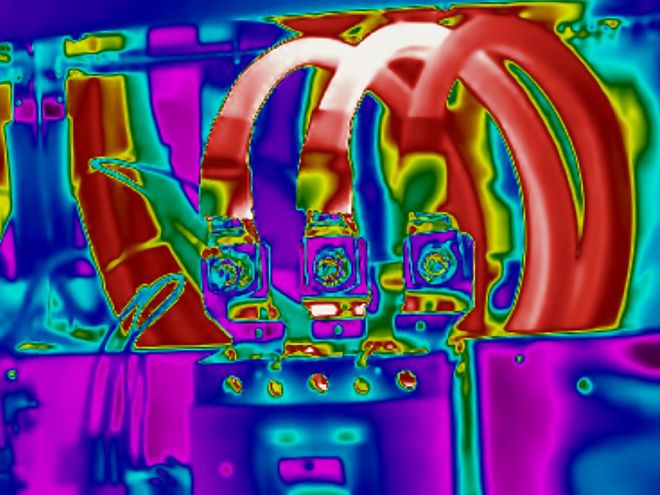


Real captures from CSE scans. Measured temperatures, rise over reference, emissivity and the load at the time of measurement are recorded against each finding in the report and are not published here.
Advisory
Small rise over reference. Watch it at the next scan.
Minor
Repair at the next convenient shutdown.
Serious
Repair as soon as practicable.
Critical
Immediate action. We call you on the day.
Graded on temperature rise over a reference point, not absolute temperature — so a warm board on a hot day isn’t wrongly flagged.
Where we scan most
Manufacturing
Production switchrooms and machine supply boards, scanned while the line is running.
Industrial
Motor starters, chiller and pump panels, capacitor banks, ATS panels.
Commercial
Office and retail MSBs, riser tap-offs, tenant TOU boards — no tenant taken offline.
REITs & property managers
Whole portfolios at volume pricing, with the same report format in every building.
Solar PV
Inverter and AC combiner boards, string terminations and isolators.
Questions we get asked
How often should we scan?
Annually suits most commercial and industrial buildings, and it lines up with the periodic inspection your appointed LEW already has to do — EMA requires that annually for most installations, six-monthly for multi-tenanted buildings and condominiums. Thermography isn’t separately mandated by EMA, but it is the practical way to find developing faults a visual inspection can’t see.
Internationally, NFPA 70B became a standard in its 2023 edition and sets infrared intervals of twelve months for equipment in good condition, six for poor. Not Singapore law, but MNC clients and insurers increasingly reference it.
Do we have to shut the power down?
No — we need the opposite. A loose joint only heats up when current flows. Switch the board off and everything cools to ambient, so the scan tells you nothing. That is exactly what makes thermography worth doing: it’s one of very few diagnostic checks you can run without taking anything offline.
What if our board is lightly loaded?
Heat from a bad joint rises with the square of the current, so a fault that’s dangerous at full load can look harmless at low load. We’ll always recommend running the board as hard as safely possible when we scan — it’s the best way to catch a real problem.
Load is something only you control, not us. If the board’s running light on the day, we’ll say so in the report — a clean result under light load is a lighter test, not a clean bill of health.
Who opens the panels?
We do, and it’s included in the rate. Our own qualified technicians remove the covers, scan, and reseal properly. You’re welcome to walk with us — most clients do — but you’re not paying an electrician to hold doors open.
How do I count my boards for pricing?
Your MSB is the site’s incoming main switchboard, priced on the first table. Everything else — additional MSBs, sub-boards, DBs, tenant TOU boards — sits on the second table and is priced on its own rated capacity. A 300A DB is $100 whether it sits beside a 400A MSB or a 6,400A one.
Easier still: send us your electrical single-line diagram. It shows every board and its rating, so we can count them and quote from the drawing alone — at no charge, and without setting foot on site.
If you find something, can you fix it?
Yes, and it’s the main reason clients come to us rather than a scan-only outfit. Two in-house Licensed Electrical Workers and a direct workforce, so rectification is quoted and carried out by the company that found the fault. Nobody has to re-explain the finding to a third party. You’re free to use your own contractor — the report is written to be actionable by anyone competent.
Why does Level 2 certification matter?
Level 1 covers collecting good thermal data under established procedures. Level 2 covers interpreting it — emissivity, reflected apparent temperature, load correction, severity classification — and taking professional responsibility for the diagnosis.
In practice it’s the difference between a folder of colourful images and someone telling you which three joints matter and what to do about them. Every CSE report is endorsed by a certified Level 2 Thermographer.
Will our insurer accept the report?
Insurers generally want a dated inspection by a certified thermographer, images and severity ratings per finding, and evidence findings were closed out. Our reports carry all three, and the $200 re-scan gives you the close-out evidence. Requirements do vary, so send us yours before the scan and we’ll confirm rather than guess.
Do you scan anything other than switchboards?
Yes — solar inverter and AC combiner boards, EV charger supply boards, motor and pump starters, chiller panels, capacitor banks and changeover panels. Anything unusual, like a busbar riser or a large UPS, tell us and we’ll confirm whether it can be scanned and what it costs.
Send us your single-line diagram. We’ll do the counting.
You don’t need to count anything. Your SLD already shows every board on the site and what each one is rated at — that is all we need to work out the tiers and send you a fixed price. No site visit, and no charge for the quotation.
No SLD to hand? Tell us roughly what you have and we will help you work it out.
Request your quote
Fixed price back, no obligation.